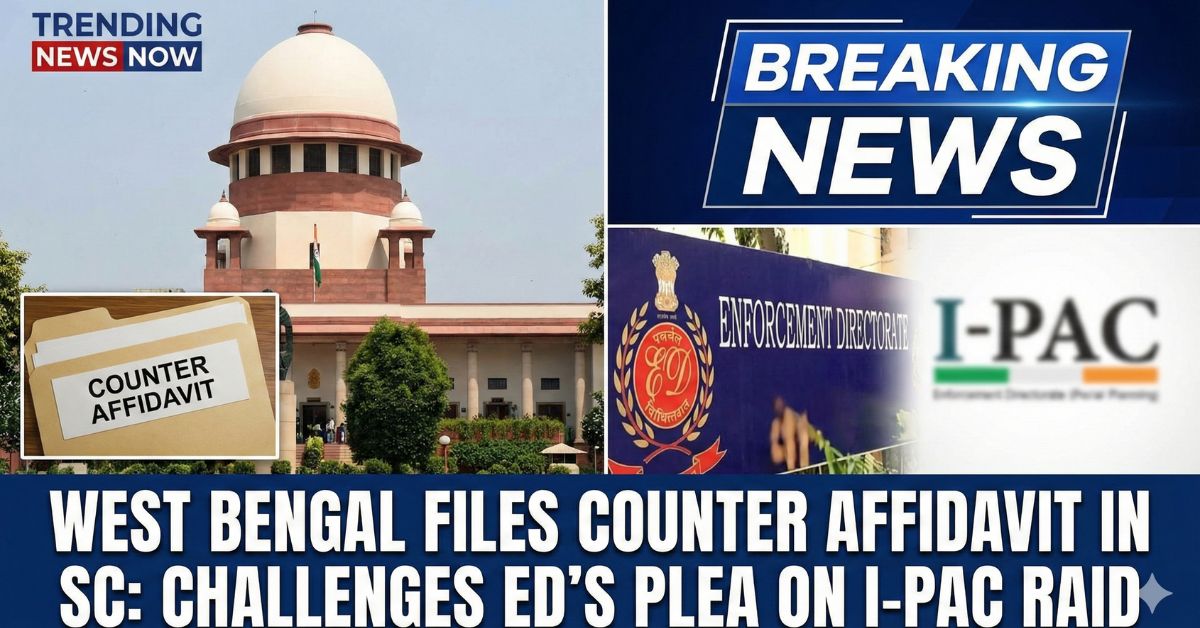
The political and legal battle between the West Bengal government and the Enforcement Directorate (ED) has taken a new turn. On Monday, February 2, 2026, the West Bengal government filed a counter affidavit in the Supreme Court. This legal document challenges the ED’s request for a probe into the alleged obstruction of their raids.
This move adds more heat to the ongoing “State vs Centre” conflict in India. Here is a simple breakdown of what happened, what the counter affidavit says, and why it matters for Indian politics.
What is the “Counter” Affidavit?
In legal terms, a counter affidavit is a written reply filed by an opposing party to answer the claims made in a petition.
In this specific case, the Enforcement Directorate (ED) had complained to the Supreme Court. They claimed that the West Bengal state machinery (police and officials) interfered when ED officers tried to raid the office of I-PAC (a political consultancy group) in Kolkata.
The West Bengal government has now formally replied to this charge by filing their counter affidavit.
Read more: Gen MM Naravane Memoir
Key Details of the West Bengal Counter
The State government’s reply focuses on a few main arguments:
- “Not Maintainable”: The West Bengal government argues that the ED’s plea should not be heard by the Supreme Court right now. They say the plea is “not maintainable” because a similar case is already pending before the Calcutta High Court.
- Jurisdiction Issue: The state argues that since the High Court is already looking into the matter, the Supreme Court should not step in at this stage.
- Denial of Obstruction: In its counter, the state government has denied the allegations that it stopped the ED officers from doing their duty.
Background: The ED vs I-PAC Issue
To understand this counter move, we need to look at the backstory:
- The Raid: The ED attempted to search the premises of I-PAC (Indian Political Action Committee) in Kolkata. This agency is known for managing political campaigns.
- The Allegation: The ED claimed that local police and state officials created hurdles, making it difficult for them to conduct the raid properly.
- The Court Case: The ED approached the Supreme Court, seeking a CBI (Central Bureau of Investigation) probe into this alleged obstruction. They also issued notices to senior state officials, including the DGP (Director General of Police).
Why This Matters for India
This incident is not just about one raid. It highlights a bigger issue in Indian democracy:
- Federal Structure: It is a classic example of the power struggle between the Central Government (which controls the ED) and a State Government.
- Agency Powers: The Supreme Court’s final decision will clarify how much protection state police can offer against central agency raids, or if central agencies have an upper hand.
- Political Timing: With upcoming elections and political shifts in 2026, these legal battles often have strong political meanings.
What Happens Next?
Now that the West Bengal government has filed its counter, the Supreme Court will review the reply.
- The bench, likely led by senior justices, will decide if the case should continue in the Supreme Court or be sent back to the Calcutta High Court.
- The ED will likely file a “rejoinder” (a reply to the counter affidavit) to defend its position.
FAQ: Understanding the Legal Battle
Q1: What is a counter affidavit?
It is a written legal response filed by a person or entity (like the State Govt) to answer the accusations made by the other side (like the ED) in court.
Q2: Why is the ED raiding I-PAC?
The ED is investigating alleged financial irregularities. They believe relevant evidence might be stored at the consultancy’s office.
Q3: What does “not maintainable” mean?
It is a legal way of saying, “This case does not follow the correct rules to be heard in this specific court right now.”
Q4: Who controls the ED?
The Enforcement Directorate (ED) operates under the Ministry of Finance, Government of India.
Q5: Will this stop the investigation?
No, the filing of a counter affidavit does not stop the investigation. It only pauses the specific court request until the judges make a decision.