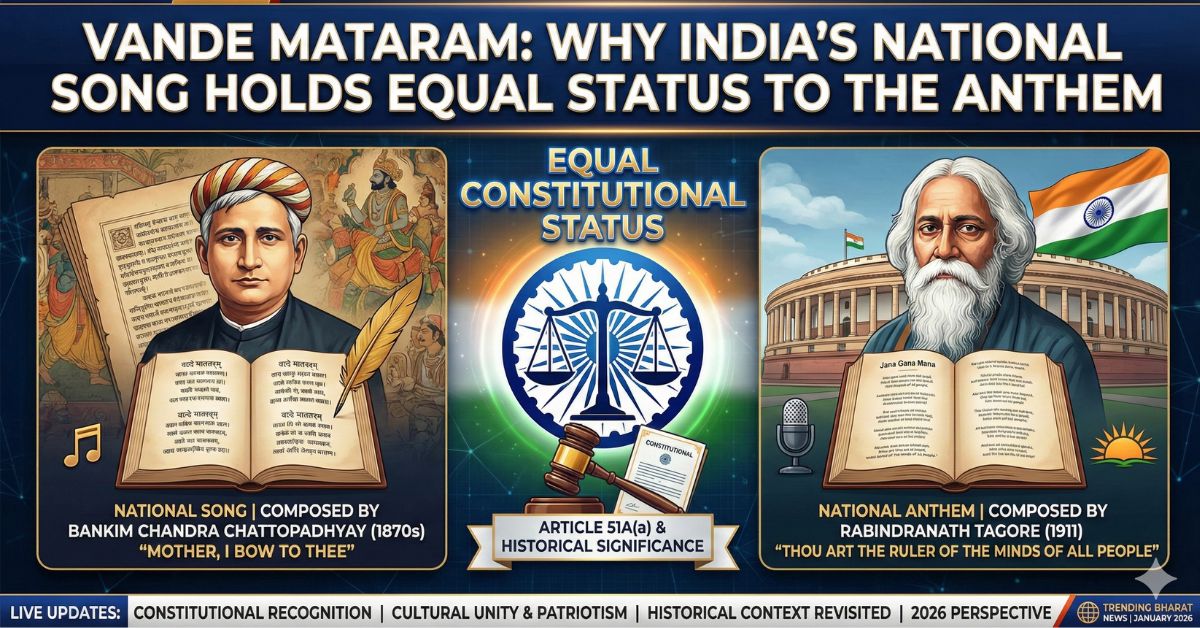
Every Indian grows up hearing the powerful verses of “Vande Mataram.” It is a song that instantly evokes a sense of deep patriotism and pride. While almost everyone knows the tune, many people often look for clarity on its history, its meaning, and how it is different from the National Anthem.
As the nation celebrates its democratic journey, interest in our national symbols always spikes. This article explores the rich legacy of India’s National Song, Rashtriya Geet, its origins in the freedom struggle, and why it holds an equal status to the National Anthem in the hearts of millions.
The Origins of Vande Mataram
The National Song of India, “Vande Mataram,” was written by the legendary Bengali poet and novelist Bankim Chandra Chatterjee. It was not written originally as a standalone song but was a poem included in his famous 1882 novel, Anandamath.
The lyrics are a beautiful blend of Sanskrit and Bengali. Bankim Chandra Chatterjee wrote the first two verses in the 1870s, years before the novel was published. The song gained massive popularity during the Indian Independence movement. It became a war cry for freedom fighters who shouted “Vande Mataram” while protesting against British rule. It was the fuel that kept the fire of nationalism burning during the partition of Bengal in 1905.
Read more: Republic Day 2026
Difference Between National Anthem and National Song
A very common confusion among people is the difference between the Rashtriya Gaan (National Anthem) and the Rashtriya Geet (National Song).
The National Anthem is “Jana Gana Mana,” written by Rabindranath Tagore. This is the official anthem played during flag hoisting and major government functions, lasting exactly 52 seconds.
On the other hand, the National Song is “Vande Mataram.” The Constituent Assembly of India adopted it on January 24, 1950. Dr. Rajendra Prasad, the first President of India, famously stated that Vande Mataram played a historic part in the struggle for Indian freedom and shall be honored equally with Jana Gana Mana. While the anthem represents the state and the territory, the National Song is often seen as a spiritual ode to the motherland itself.
Meaning and Significance
The phrase “Vande Mataram” translates to “I bow to thee, Mother.” The song personifies India as a mother goddess who is rich in water, fruits, and breeze. It describes the beauty of the land and the strength of its people.
Historically, this song did more than just describe the country; it united people. During the freedom struggle, the British government actually banned the singing of Vande Mataram in public spaces, fearing it would incite rebellion. Many freedom fighters were imprisoned just for singing these verses. This history of sacrifice is why the song is treated with such high reverence today.
Code of Conduct and Respect
Unlike the National Anthem, which has very strict laws regarding its playing and the requirement to stand at attention, the rules for the National Song are more about tradition and moral duty rather than legal punishment.
However, the general code of conduct suggests that whenever Vande Mataram is sung or played, one should stand in respect. It is widely sung in schools, colleges, and at the beginning of Parliament sessions. Over the years, courts have generally observed that while there is no penal provision for not singing it, showing respect to the National Song is a fundamental duty of every citizen who values the country’s history.
Why It Matters Today
In modern India, Vande Mataram continues to be a unifying force. It is frequently performed by musical maestros and remains a staple during Republic Day and Independence Day celebrations. The song reminds the younger generation of the sacrifices made to secure the country’s liberty. It bridges the gap between the past and the present, ensuring that the spirit of the freedom struggle is never forgotten.
Frequently Asked Questions (FAQs)
Q1: Who wrote the National Song of India?
The National Song, Vande Mataram, was written by Bankim Chandra Chatterjee.
Q2: Is Vande Mataram the National Anthem?
No, Vande Mataram is the National Song (Rashtriya Geet). The National Anthem (Rashtriya Gaan) is Jana Gana Mana.
Q3: From which novel is Vande Mataram taken?
The song was taken from Bankim Chandra Chatterjee’s novel titled Anandamath, published in 1882.
Q4: When was Vande Mataram adopted as the National Song?
It was officially adopted by the Constituent Assembly of India on January 24, 1950.
Q5: Is it mandatory to stand for the National Song?
While there is no strict penal law like there is for the National Anthem, it is considered a fundamental duty and a sign of respect to stand when the National Song is played.