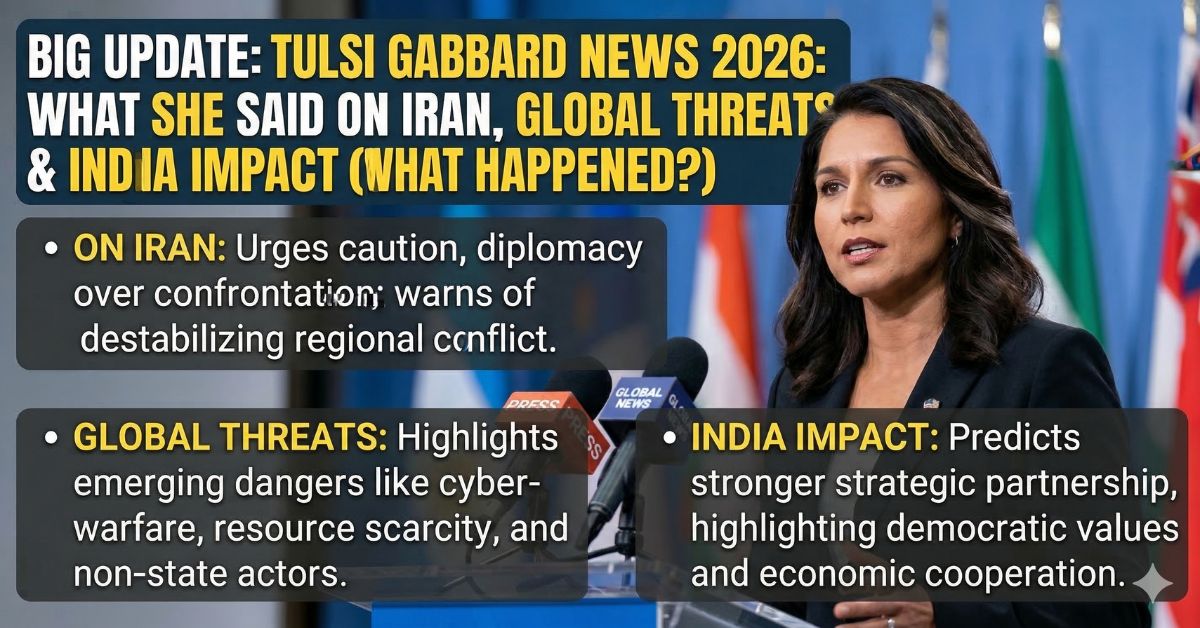
Tulsi Gabbard has become one of the most talked-about global political figures again. As the current US Director of National Intelligence, her latest statements on Iran, global security threats, and intelligence policies are making headlines worldwide — including in India.
In this article, we explain who Tulsi Gabbard is, what she recently said, the key developments, and why her role matters for India and global politics.
Who Is Tulsi Gabbard?
Tulsi Gabbard is an American politician and military officer. She is currently serving as the US Director of National Intelligence (DNI) since February 2025.
She previously served as a US Congresswoman from Hawaii and has also been part of the US Army Reserve. Over the years, she has been known for her strong views on foreign policy and national security.
What Happened Recently?
Tulsi Gabbard was in the news after appearing before the US Senate Intelligence Committee in March 2026. During this hearing, she presented the Annual Threat Assessment and answered questions on global conflicts, especially the ongoing tensions involving Iran.
Her remarks came at a time when the US is facing criticism over its military actions in the Middle East.
Key Statements by Tulsi Gabbard
Iran’s Military Power Weakened but Not Destroyed
Gabbard said that recent US military actions have significantly weakened Iran’s capabilities, but the regime is still intact and may try to rebuild.
She also stated that Iran’s nuclear infrastructure has been heavily damaged and no rebuilding efforts have been seen so far.
At the same time, she warned that Iran could take time to recover and rebuild its weapons systems if it survives the current situation.
Debate Over “Imminent Threat”
One of her most discussed comments was about intelligence agencies. She said that it is not the job of intelligence agencies to decide what counts as an “imminent threat.”
This statement has triggered political debate in the US, especially about who should take responsibility for decisions that lead to war.
Global Threats: China, Russia, Pakistan and More
In the 2026 threat assessment, Gabbard highlighted that countries like China, Russia, Iran, North Korea, and Pakistan pose major strategic and nuclear risks to the US.
She also warned about emerging risks like cyber attacks, artificial intelligence misuse, and terrorism networks.
Political Controversy in the US
Her testimony also comes amid political tensions in the US. Questions were raised about:
Read More : Ajit Doval Meets US Envoy 2026
- The justification behind US strikes on Iran
- Differences within the administration
- Resignation of key officials over policy disagreements
Some lawmakers accused the intelligence community of not being fully transparent.
Why This Matters for India
Tulsi Gabbard’s role is important for India for several reasons:
1. India-US Strategic Partnership
India and the US share strong ties in defence and intelligence. Gabbard has previously met Prime Minister Narendra Modi and discussed cooperation on security and counter-terrorism.
2. Indo-Pacific Focus
Her policy approach includes strengthening partnerships in the Indo-Pacific region, where India plays a key role in balancing China.
3. Regional Security Impact
Any escalation involving Iran or global powers can affect:
- Oil prices (important for India)
- Trade routes
- Geopolitical stability
Background: US-Iran Conflict
The current tensions stem from US military strikes targeting Iran’s infrastructure. According to intelligence assessments:
- Iran’s military capacity has been heavily reduced
- Its nuclear program has suffered major damage
- But the political regime remains in power
These developments have created uncertainty about future conflict or peace.
What Happens Next?
The situation remains uncertain. Experts believe:
- Iran may attempt to rebuild its military strength
- Diplomatic talks could increase
- Global tensions may continue in the short term
In the US, more hearings and political debates are expected over the decisions taken.
FAQ(Tulsi Gabbard)
1. Why is Tulsi Gabbard trending?
She is trending due to her recent statements on Iran, global threats, and US intelligence policy during a Senate hearing.
2. What is her current position?
She is the Director of National Intelligence in the United States.
3. What did she say about Iran?
She said Iran’s military power is weakened, but the regime is still intact and could rebuild.
4. Does her statement affect India?
Indirectly, yes. Global conflicts impact oil prices, trade, and India’s strategic partnerships.
5. Is there a war going on with Iran?
There have been military actions and tensions, but the situation is still evolving and not officially declared as a full-scale war.