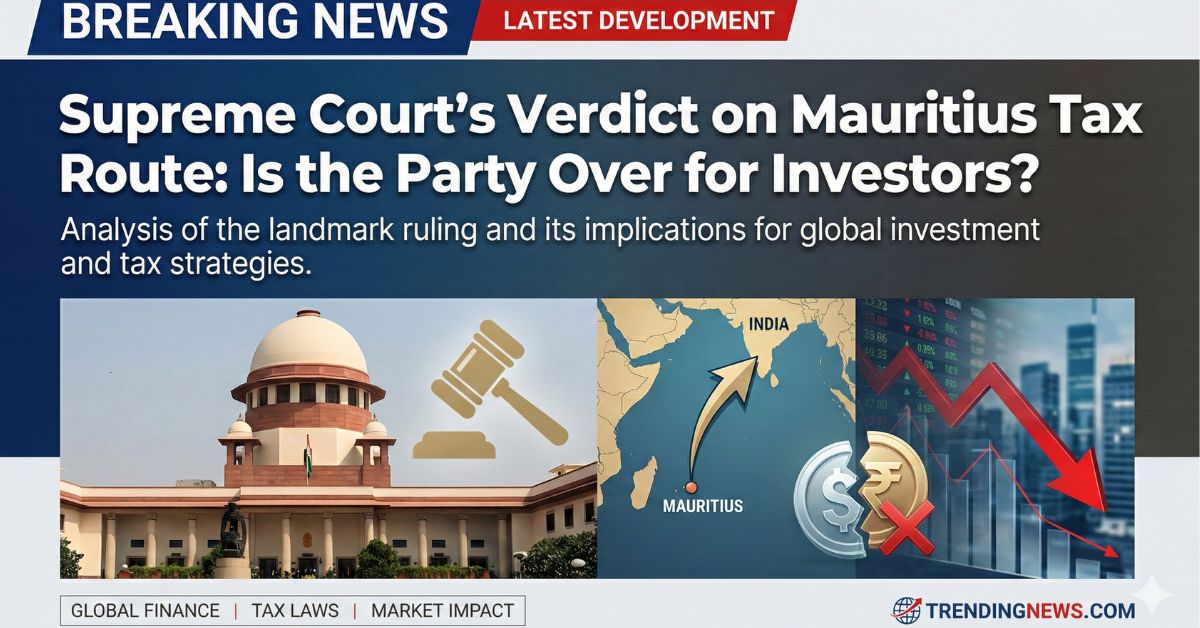
For decades, Mauritius has been the favorite gateway for foreign investors to send money to India. It was famous for its tax benefits. But in a major turn of events this January 2026, the Supreme Court of India has delivered a strict verdict that changes the rules of the game.
The top court has ruled that foreign companies cannot claim tax benefits just by showing a certificate from Mauritius. They must prove they have real business operations there. This ruling, coming from the high-profile Tiger Global vs. Flipkart case, has sent shockwaves through the startup and investment world.
If you are following the Indian stock market, startup funding, or global trade news, this is a critical update you cannot ignore. Here is a simple breakdown of what happened and why it matters to India.
The Tiger Global Verdict: What Happened?
The story revolves around a deal from 2018. Tiger Global, a major US-based investment firm, sold its stake in the Indian e-commerce giant Flipkart to Walmart. They made a massive profit (capital gains) from this sale.
Tiger Global tried to claim a tax exemption on these profits. They argued that because their investment came through a company registered in Mauritius, they were protected by the India-Mauritius Double Taxation Avoidance Agreement (DTAA).
However, the Indian Tax Department rejected this claim. They argued that the Mauritius entity was just a “shell company” (a company on paper only) created solely to save tax.
The Verdict: The Supreme Court agreed with the Tax Department. It ruled that Tiger Global must pay tax in India. The court said that just having a Tax Residency Certificate (TRC) is not enough proof to claim treaty benefits anymore.
Read more: Jerome Powell vs. Trump
Why the ‘Grandfathering’ Clause Didn’t Save Them
This is the technical part, but it is important to understand.
In 2017, India and Mauritius updated their tax treaty. They decided that shares bought before April 1, 2017, would still be tax-free (this protection is called “grandfathering”). Since Tiger Global bought Flipkart shares before 2017, they thought they were safe.
The Twist: The Supreme Court said that even if the investment was made before 2017, the “Grandfathering” rule does not protect against tax evasion. If the company in Mauritius had no real office, no staff, and no independent decision-making power, the court can look through the structure and tax the real owner (in this case, the US firm).
This means the General Anti-Avoidance Rule (GAAR) is now more powerful than the old treaty protections.
What is ‘Commercial Substance’?
The court used a key term: “Commercial Substance.”
To claim tax benefits in the future, a Mauritius-based company must prove it is “real.”
- Does it have a physical office in Mauritius?
- Does it have local employees?
- Does it spend money on operations there?
- Do the directors in Mauritius actually make decisions, or do they just sign papers sent from the US or India?
If the answer is “No,” the Indian taxman will treat the company as a shell entity and deny tax benefits.
Impact on Startups and Foreign Investors
This ruling is a wake-up call for the Indian startup ecosystem.
- Higher Tax Bills: Many foreign investors who exited Indian startups in recent years might now face tax notices.
- Funding Slowdown: Investors might become more cautious. They will now have to set up proper offices in Mauritius or Singapore, which costs more money.
- End of an Era: The “easy” tax-saving route via Mauritius is effectively over. India is sending a message that it wants “clean” investment, not just tax-saving structures.
Strategic Update: The Chagos Islands Tension
While the tax news is dominating business headlines, Mauritius is also trending in India for geopolitical reasons this week.
There is fresh tension regarding the Chagos Islands. A proposed treaty for the UK to hand over these islands to Mauritius is facing delays due to criticism from the US administration. India has historically supported Mauritius’ claim over the islands. This is important for India’s security because of the strategic naval base at Diego Garcia.
While the business world focuses on taxes, India’s diplomats are closely watching the Chagos situation to ensure regional stability in the Indian Ocean.
Frequently Asked Questions (FAQs)
1. Is the Mauritius tax route completely closed now?
No, it is not closed. You can still invest through Mauritius. However, you cannot use a “paper company” just to save tax. You must have a real office and business presence there to get tax benefits.
2. What is the Grandfathering Clause?
It was a rule that allowed investments made before April 1, 2017, to remain tax-free in India, even after the tax laws changed. The Supreme Court has now limited this protection if the company lacks “commercial substance.”
3. How does this affect the Indian stock market?
Short-term, it might create nervousness among foreign investors (FIIs). They may sell some stocks or pause new investments to review their tax structures. Long-term, it brings more transparency.
4. Does this ruling apply to Singapore too?
Yes, likely. The India-Singapore tax treaty is very similar to the Mauritius one. Courts often apply the same logic to both.
5. What should startups do?
Startups do not need to panic, but they should inform their investors. Future fundraising legal paperwork will need to be much stricter to ensure investors comply with Indian tax laws.