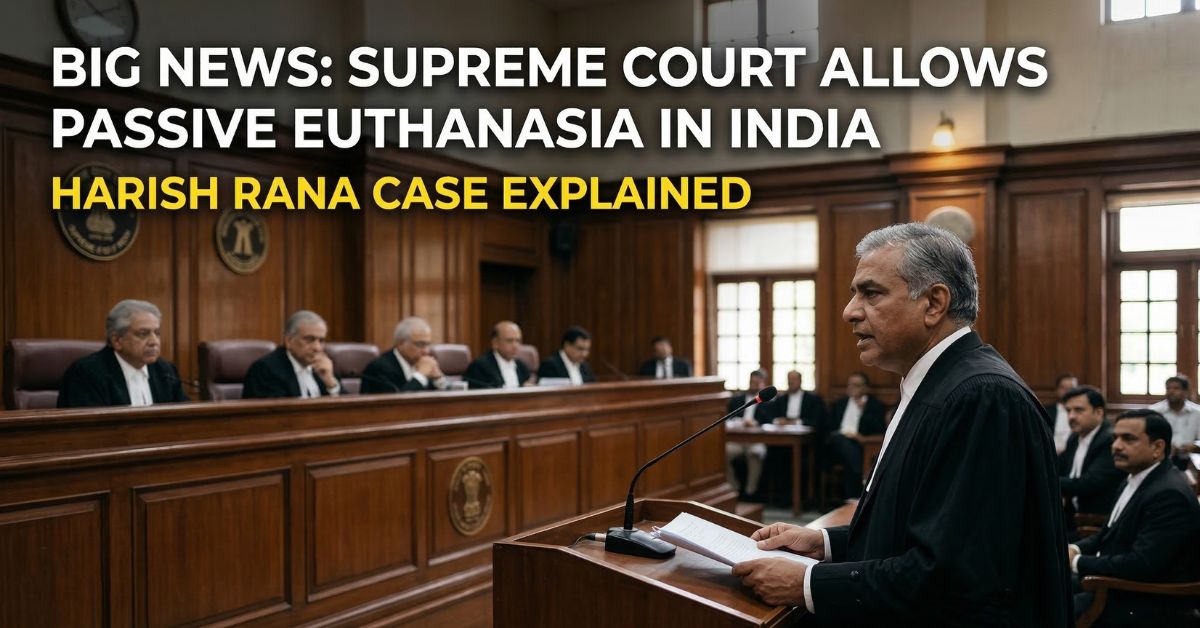
India’s Supreme Court Allows Passive Euthanasia in India recently delivered a historic judgment that has reignited national debate on the “right to die with dignity.” In March 2026, the court allowed the withdrawal of life-sustaining treatment for Harish Rana, a man who had been in a vegetative state for more than 13 years.
This decision is considered a major moment in India’s legal history because it is the first time the Supreme Court Allows Passive Euthanasia in India Court has allowed passive euthanasia in such a case after reviewing medical reports and family consent. The ruling also raises important questions about end-of-life care, medical ethics, and the rights of patients and families in India.
What Happened in the Supreme Court Case
The Supreme Court Allows Passive Euthanasia in India permitted doctors to withdraw life support for Harish Rana, a 31-year-old man from Ghaziabad who had been in a permanent vegetative state since 2013 after suffering severe head injuries from a fall.
Rana was a student at Panjab University when the accident happened. Since then, he had remained in a coma-like condition with no meaningful recovery despite years of medical care.
After examining medical reports and hearing the plea of his parents, the Supreme Court ruled that continuing treatment would not serve any medical purpose. The bench of Justices J.B. Pardiwala and K.V. Viswanathan therefore allowed doctors to withdraw artificial life-support measures.
The court also directed the All India Institute of Medical Sciences (AIIMS), Delhi, to manage the withdrawal process carefully to ensure dignity and minimize suffering.
Understanding Passive Euthanasia
Passive euthanasia means allowing a patient to die naturally by withdrawing or withholding medical treatment that keeps them alive, such as feeding tubes or life-support systems.
It is different from active euthanasia. Active euthanasia involves intentionally causing death through medication or injections, which is still illegal in India.
India legally recognized passive euthanasia through earlier Supreme Court Allows Passive Euthanasia in India rulings, including the Aruna Shanbaug case (2011) and the Common Cause judgment (2018). These decisions established that the “right to die with dignity” is part of the fundamental right to life under Article 21 of the Constitution.
However, actual court-approved cases have been extremely rare, making the Harish Rana judgment particularly significant.
Why the Court Allowed Withdrawal of Treatment
The Supreme Court Allows Passive Euthanasia in India considered several important factors before making its decision.
First, medical boards confirmed that Rana’s condition was irreversible and that he had no realistic chance of recovery.
Second, the family unanimously supported the request to stop life-sustaining treatment after years of care and emotional hardship.
Finally, the court emphasized that the decision was not about giving up on life but about preserving dignity when medical science cannot offer recovery. Judges said that prolonging biological life without hope of improvement may not always be in a patient’s best interest.
Why This Supreme Court Decision Matters
This judgment has wider implications for India’s healthcare and legal systems.
First, it clarifies how passive euthanasia guidelines can be applied in real cases, providing direction for hospitals, doctors, and families dealing with similar situations.
Second, it brings renewed attention to living wills—legal documents where people can state their wishes about life-support treatment if they become terminally ill or unconscious.
Third, the court urged the central government to consider creating a comprehensive law on end-of-life care so that such cases can be handled with clearer legal procedures in the future.
Impact on Healthcare and Families in India
For many families caring for patients in long-term vegetative states, this decision highlights the legal path available under strict medical and judicial supervision.
Doctors and hospitals must still follow detailed guidelines before withdrawing treatment. Usually, multiple medical boards must confirm that recovery is impossible and that stopping treatment is in the patient’s best interest.
The case also reminds society about the emotional and financial burden families often face when caring for patients with irreversible conditions.
What Happens Next in the Harish Rana Case
Following the Supreme Court Allows Passive Euthanasia in Indiat order, Rana will be moved to the palliative care department at AIIMS in Delhi.
Read More : High Court allahabad update 2026
Medical teams will supervise the withdrawal of treatment in a controlled and humane manner. The focus will be on comfort care so that the patient experiences minimal suffering during the final stage.
The case is expected to influence future legal discussions on euthanasia and end-of-life care policies in India.
FAQs(Supreme Court Allows Passive Euthanasia in India)
What did the Supreme Court decide in the Harish Rana case?
The Supreme Court allowed doctors to withdraw life-support treatment for Harish Rana, who had been in a vegetative state since 2013.
Is euthanasia legal in India?
Passive euthanasia is legal under strict guidelines, but active euthanasia is still illegal in India.
What is passive euthanasia?
Passive euthanasia means stopping or withdrawing medical treatment that artificially keeps a patient alive, allowing natural death.
What is a living will?
A living will is a legal document where a person states their wishes about medical treatment if they become terminally ill or unconscious in the future.
Why is this Supreme Court decision important?
It sets a legal precedent and clarifies how passive euthanasia can be implemented under India’s existing legal framework.