Quick snapshot: why this is trending in India
If you saw searches like “Israel President” and “Modi Israel visit 2026” suddenly climb on Google Trends, there’s a clear reason: Prime Minister Narendra Modi made a two-day state visit to Israel on February 25–26, 2026, and one of the headline moments was his meeting with Israel’s President Isaac Herzog in Jerusalem.
People usually search this keyword when they want fast clarity on a few things: Did the visit really happen? When exactly? Who did Modi meet—only Israel’s Prime Minister, or also the President? What big announcements came out of it for India, especially on defence, jobs, tech, payments like UPI, and trade?
This article covers the full picture in simple English: what happened during the visit, what was said in official updates, what deals and outcomes were listed, why the “Israel President” meeting matters, and what could come next for India–Israel ties.
What happened: Modi’s state visit to Israel (Feb 25–26, 2026)
India’s official readout said PM Modi travelled to Israel on a state visit on February 25–26, 2026, after being invited by Israel’s Prime Minister Benjamin Netanyahu. It was described as Modi’s second visit to Israel as Prime Minister.
The official plan was straightforward but important. Modi was expected to:
- meet Prime Minister Netanyahu to review the India–Israel strategic partnership and identify new areas for cooperation, and
- call on President Isaac Herzog.
This matters because, in diplomatic terms, meeting both the head of government (Prime Minister) and the head of state (President) sends a strong signal of priority. It’s also a sign the visit was not only about one issue—like defence—but about the full relationship: technology, trade, security, agriculture, water, and people-to-people links.
The “Israel President” angle: Modi meets President Isaac Herzog
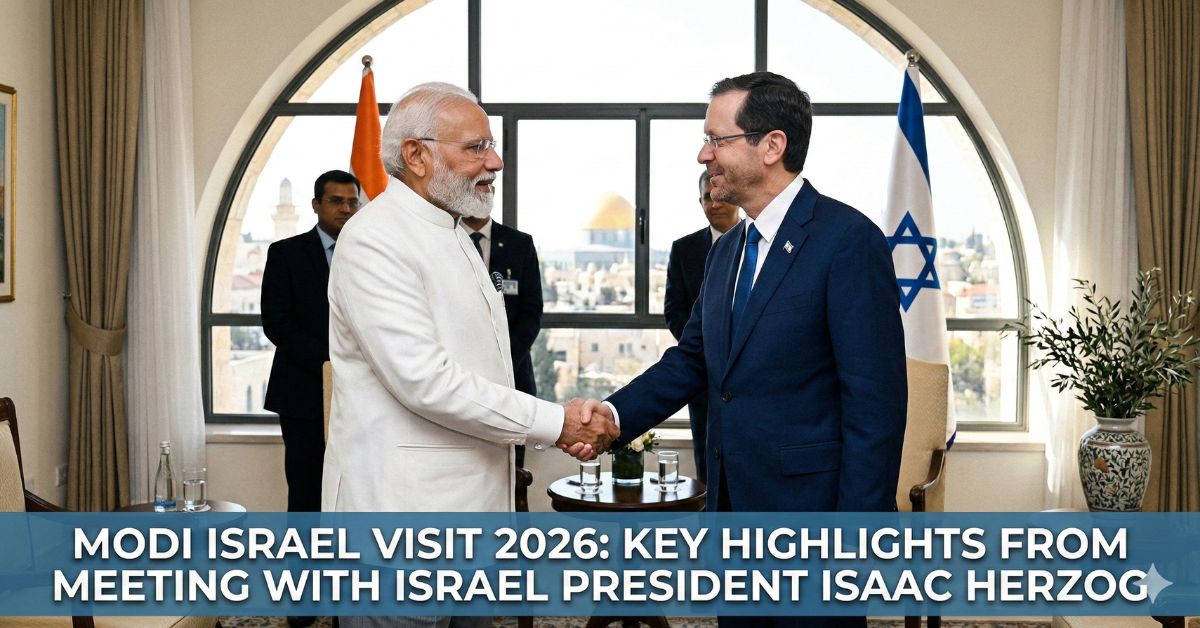
On February 26, 2026, India’s PM met Israel’s President Isaac Herzog in Jerusalem, according to the Prime Minister’s Office update.
What was discussed in the meeting
The official note said both leaders spoke about ongoing cooperation across trade, technology, innovation, defence and security, and counter-terrorism. They also discussed regional issues, including support for a Gaza peace plan and progress linked to that initiative.
A key line in the update was that both sides connected this meeting to the broader upgrade of ties—calling it a “Special Strategic Partnership for Peace, Innovation and Prosperity.” In simple terms, the President meeting was not treated as a side event. It was framed as part of a “new beginning” in the relationship, tied to shared democratic values and long-term trust.
The symbolic gesture that stood out
Beyond formal talks, the PMO note highlighted a public, symbolic moment: Modi, President Herzog, and Israel’s First Lady planted a tree in the President’s garden under India’s “Ek Ped Maa Ke Naam (One Tree for Mother)” initiative.
Why did this become shareable and “trend-worthy” online? Because symbolic gestures are easy for people to understand quickly. They also work as diplomatic messaging: it shows warmth, personal comfort between leaders, and a positive story beyond hard security topics.
Big headline outcome: India–Israel ties upgraded
The biggest official headline from the visit was the decision to elevate the relationship to a “Special Strategic Partnership for Peace, Innovation and Prosperity.”
So, what does that mean in normal language?
It means both governments are signalling: “We want this relationship to be deeper, broader, and more future-focused than before.” The official texts repeatedly link the upgrade to technology-led growth, innovation, defence cooperation, and stronger institutional mechanisms so projects don’t stay stuck at the announcement stage.
It also gives political cover for faster decision-making later—because once you brand a partnership at a higher level, ministries and agencies often get clearer instructions to deliver outcomes.
Key focus areas highlighted during Modi–Netanyahu talks
The PMO update on Modi’s talks with Netanyahu said the discussions covered the entire partnership, with specific emphasis on trade and investment, defence and security, space, energy, critical technologies, cyber security, education, scientific research, and innovation.
The same update also mentioned areas where India and Israel see “transformative potential,” including agriculture, water management, start-ups, fintech, digital healthcare, biotechnology, and advanced pharma.
In short: this was positioned as a “future economy” partnership, not a single-issue relationship.
Trade and economy: the FTA push (what we know so far)
One of the most searched angles in India after such visits is: “Will this help trade, investment, or Indian companies?”
The India–Israel joint statement said both sides welcomed the signing of Terms of Reference for Free Trade Area (FTA) negotiations, noted that the first negotiating round was held in New Delhi, and said teams were tasked to speed up negotiations for an early signing.
That’s an official way of saying: “We have started formal steps, and we want to move quicker.” But it does not mean an FTA is already final. Many trade deals take time because they involve sensitive areas like tariffs, market access, standards, and services.
For India, an FTA could matter in practical ways:
- easier market access for Indian goods and services,
- more predictable rules for Indian investors,
- and deeper business-to-business links (especially in tech and manufacturing).
But the key point is freshness: as of the Feb 26, 2026 joint statement, it’s still in negotiation mode, with political push for speed.
UPI in Israel: what was announced, and what it could change
UPI is a powerful keyword in India because it connects directly to daily life. During the visit, the joint statement said both sides agreed to explore linking India’s UPI with Israel’s fast payment system and welcomed an MoU involving NPCI International and MASAV to examine payment linkages for cross-border payments.
Read More : India-Israel Relations Strengthen as PM Modi Visits Israel in 2026
The PMO “List of Outcomes” also described an MoU between NPCI International and MASAV aimed at enabling cross-border remittances between India and Israel through UPI.
What it could mean for Indians
If implemented smoothly, this could eventually help:
- Indian workers in Israel send money home more easily,
- Indian tourists pay digitally with fewer frictions,
- and small businesses reduce dependence on expensive transfer channels.
What is still unclear
What’s not clearly stated yet in the official notes is the rollout timeline for public use, which banks/payment apps would support it first, and what compliance steps will be needed. So for now, treat it as an official agreement to move toward connectivity—big signal, but not “live for everyone tomorrow.”
FAQ
1) Why did PM Modi visit Israel in 2026?
PM Modi visited Israel in February 2026 to strengthen India–Israel relations. The visit focused on defence cooperation, technology partnerships, trade expansion, digital payments, agriculture, and regional security issues. It was also aimed at upgrading the relationship to a higher strategic level and speeding up talks on a possible Free Trade Agreement (FTA).
2) Who is the Israel President who met PM Modi during the 2026 visit?
The President of Israel who met PM Modi during the visit was Isaac Herzog. The meeting took place in Jerusalem. Both leaders discussed cooperation in innovation, defence, trade, and regional peace efforts. The meeting highlighted the strong diplomatic ties between the two countries.
3) What were the key outcomes of Modi’s Israel visit 2026?
Some major outcomes included upgrading India–Israel ties to a “Special Strategic Partnership,” progress in FTA negotiations, discussions on linking India’s UPI payment system with Israel’s payment network, and expanded cooperation in defence, agriculture, water management, and emerging technologies like AI and cybersecurity.
4) Did India and Israel sign any agreements during Modi’s 2026 visit?
Yes, both sides agreed to move forward on several cooperation areas. This included steps toward linking UPI for cross-border payments and advancing Free Trade Agreement negotiations. Official statements confirmed new memorandums of understanding (MoUs) and plans to deepen collaboration across multiple sectors.
5) How will Modi’s meeting with the Israel President impact India?
The meeting strengthens diplomatic trust and opens doors for deeper cooperation in defence, trade, and technology. For India, this could mean better access to Israeli innovation, stronger security collaboration, smoother payment systems for Indians in Israel, and improved business opportunities in the future.