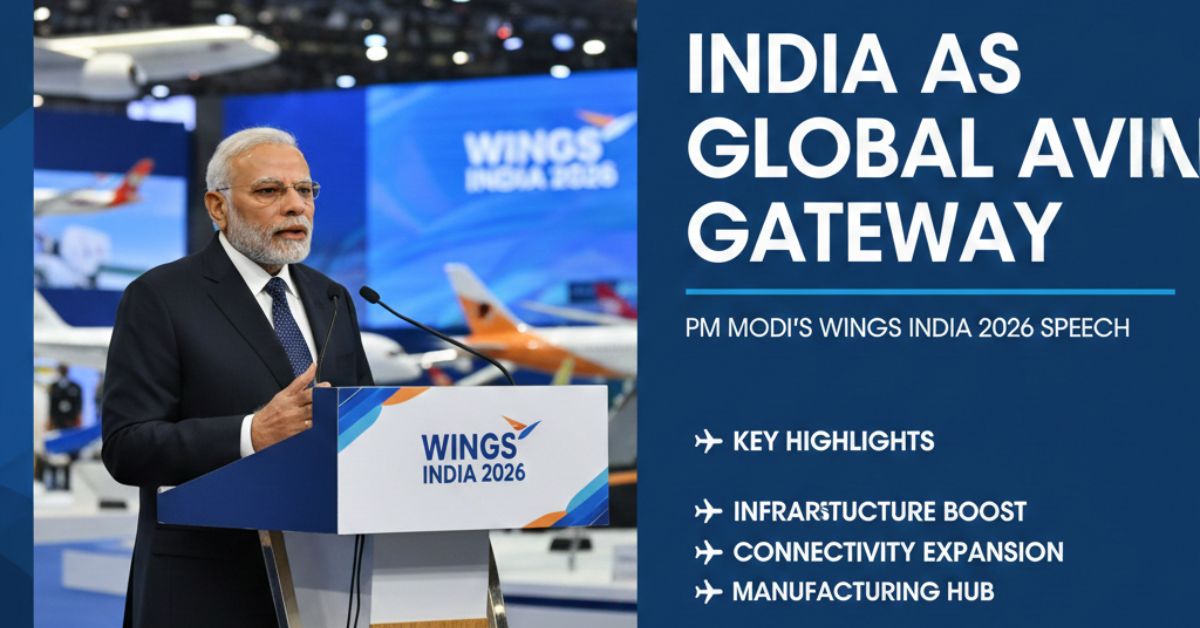
The Indian aviation sector has reached a historic milestone, with Prime Minister Narendra Modi declaring that the country has now emerged as a critical aviation gateway between the Global South and the rest of the world. Speaking at the Wings India 2026 event in Hyderabad on January 28, the Prime Minister highlighted how India has transformed from an exclusive club for the wealthy into the world’s third-largest domestic aviation market.
This transformation is not just about passenger numbers; it marks a strategic shift in how India connects with the world. The “gateway” concept refers to India’s growing role as a trans-shipment hub, a manufacturing base for aircraft parts, and a central point for international travel routes that bypass traditional Western hubs.
The Shift to a Global Aviation Hub
Prime Minister Modi emphasized that the growth of the aviation sector is the result of a decade-long vision. In 2014, India had only 70 airports. Today, that number has surged to over 160. This rapid expansion has been supported by the UDAN scheme, which has allowed nearly 15 million passengers to fly on routes that previously did not exist.
By positioning India as a gateway, the government aims to leverage the country’s geographical advantage. Situated between the East and the West, India is perfectly placed to handle the rising demand for travel and cargo from developing nations in Asia, Africa, and Latin America—collectively known as the Global South.
Read more: 8th Pay Commission News
Beyond Travel: Manufacturing and Cargo
A key part of the new “gateway” strategy is making India self-reliant in aviation technology. The Prime Minister noted that India has already begun domestic production of military and transport aircraft. The next step is civil aircraft manufacturing.
The focus is also shifting heavily toward air cargo and logistics. The government is implementing regulatory reforms to make the movement of goods faster and more transparent. Digital cargo platforms and modern warehouses are being built to reduce logistics costs, which will eventually make Indian exports more competitive globally.
Why This Matters for the Indian Economy
For the average Indian citizen, this growth means better connectivity and more jobs. The aviation ecosystem—including maintenance, repair, and overhaul (MRO) services, pilot training, and ground handling—is expected to create thousands of high-skill opportunities.
Furthermore, the “gateway” status boosts tourism. As India becomes a primary entry point for international travelers, local businesses in Tier-2 and Tier-3 cities stand to benefit from increased footfall. The government has also announced plans for the next phase of the UDAN scheme, which will include seaplane operations to reach the most remote parts of the country.
Looking Ahead: 400 Airports by 2047
The vision for “Viksit Bharat” (Developed India) by 2047 includes a massive infrastructure goal: increasing the number of airports to over 400. This long-term plan aims to ensure that no citizen is more than a short drive away from an airport.
As the Budget Session of Parliament begins this week, the industry is looking for further tax incentives and policy support to sustain this momentum. With the Union Budget 2026-27 set to be presented on February 1, the aviation sector remains a top priority for national development.
Frequently Asked Questions (FAQs)
What does “Aviation Gateway” mean?
An aviation gateway is a primary hub that connects different regions of the world. In this context, it means India is becoming a central point for international flights, cargo movement, and aircraft manufacturing, especially for countries in the Global South.
What is the UDAN scheme?
UDAN (Ude Desh ka Aam Nagrik) is a regional connectivity scheme launched by the Government of India. It aims to make air travel affordable for the common man by developing smaller regional airports and subsidizing tickets on these routes.
How many airports does India have now?
As of early 2026, India has more than 160 operational airports. This is a significant increase from the 70 airports the country had in 2014.
What was the Wings India 2026 event?
Wings India is Asia’s largest civil aviation event. The 2026 edition was held in Hyderabad and served as a platform for global leaders, investors, and manufacturers to discuss the future of the aviation industry and showcase new technologies.
Is India making its own planes?
Yes, India has started manufacturing military and transport aircraft domestically. The Prime Minister has indicated that the country is now moving toward manufacturing civil (commercial) aircraft as well.