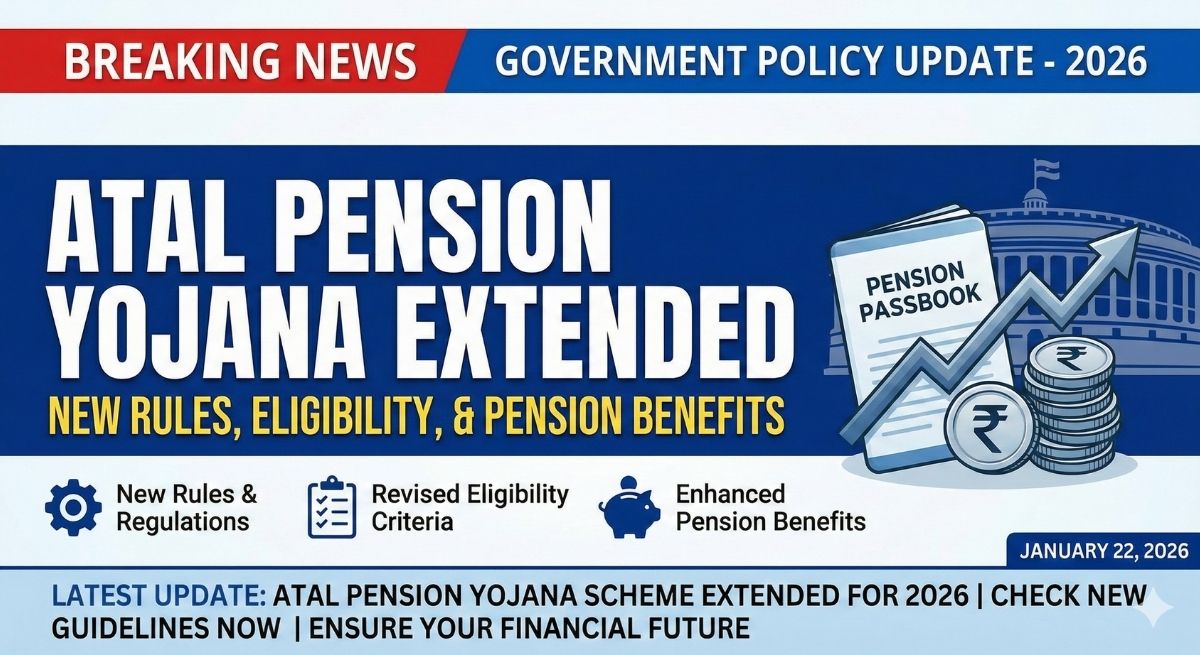
Great news for workers in India’s unorganized sector seeking financial security for their old age. The Union Cabinet has recently approved the extension of the popular Atal Pension Yojana (APY) until 2030-31. This government-backed scheme guarantees a fixed monthly pension after retirement, ensuring a steady income flow when you need it most. Let’s dive into the details of what this scheme offers, the crucial rules for income tax payers, and how you can secure your future.
What is the Atal Pension Yojana (APY)?
Launched by the Prime Minister in May 2015, the Atal Pension Yojana is a social security scheme aimed primarily at the unorganized sector. Its main goal is to provide a defined pension, guaranteed by the Government of India, to citizens after they attain the age of 60. It encourages workers to save small amounts voluntarily during their productive years to build a retirement corpus. The scheme is administered by the Pension Fund Regulatory and Development Authority (PFRDA) through the National Pension System (NPS) architecture.
Key Features and Benefits of APY
The APY scheme offers several attractive benefits designed to provide financial stability in old age.
Guaranteed Monthly Pension
The most significant benefit is the guaranteed minimum monthly pension. Subscribers will receive a fixed pension of ₹1,000, ₹2,000, ₹3,000, ₹4,000, or ₹5,000 after turning 60. The pension amount depends on the contribution made by the subscriber, which varies based on the age of joining.
Benefits for Spouse and Nominee
The scheme provides security for the subscriber’s family as well.
- For the Spouse: In the unfortunate event of the subscriber’s death after 60, the spouse is entitled to receive the same guaranteed pension amount for their entire lifetime.
- For the Nominee: After the death of both the subscriber and the spouse, the entire accumulated pension corpus is returned to the nominee.
Tax Benefits
Investments made in the Atal Pension Yojana are eligible for tax deductions. Contributions qualify for benefits under Section 80CCD(1B) of the Income Tax Act, which is over and above the ₹1.5 lakh limit under Section 80C.
Important Eligibility Rules: Who Can and Cannot Join?
To join the Atal Pension Yojana, you must meet specific criteria. It is crucial to understand the recent changes in rules.
Age and Bank Account
- Citizenship: You must be an Indian citizen.
- Age Limit: The entry age is between 18 and 40 years. This means a subscriber must contribute for a minimum of 20 years to get the pension.
- Bank Account: You need to have a valid savings bank account or a post office savings account. Your mobile number should be linked to this account.
The Major Rule for Income Tax Payers
A significant rule change was implemented from October 1, 2022. Any citizen who is or has been an income-tax payer is NOT eligible to join the Atal Pension Yojana.
If a person joined the scheme on or after this date and is later found to have been an income tax payer on or before the date of application, their APY account will be closed. The accumulated pension wealth contributed by the subscriber will be refunded to them.
How Contributions Work
Your contribution amount depends on two factors: the age at which you join the scheme and the monthly pension amount you wish to receive.
- Younger Entry, Lower contribution: If you join early at the age of 18, you will have to pay a smaller monthly amount compared to someone joining at the age of 35 or 40 to get the same pension.
- Auto-Debit Facility: Contributions are automatically debited from your linked savings bank account. You can choose a payment frequency that suits you: monthly, quarterly, or half-yearly. You must ensure your account has sufficient balance on the due date to avoid penalty charges.
Latest Update: APY Extended Till 2030-31
In a move to further strengthen social security for unorganized workers, the Union Cabinet in January 2026 approved the continuation of the Atal Pension Yojana for another five years, up to 2030-31. This extension reflects the government’s ongoing commitment to ensuring that millions of workers without formal retirement benefits can look forward to a secure future.
How to Apply for Atal Pension Yojana
You can open an APY account through both online and offline modes.
- Offline: Visit your nearest bank branch or post office where you hold a savings account. Ask for the APY registration form, fill it out, and submit it along with the required documents (like Aadhaar card).
- Online: Many banks offer the facility to open an APY account through their net banking platforms. You can also register online through the eNPS portal using your Aadhaar details.
Exit and Withdrawal Rules
- On attaining 60 years: You can exit the scheme and start receiving your guaranteed monthly pension. You can also opt to withdraw 100% of the accumulated corpus if you prefer not to receive the pension.
- Before 60 years: Voluntary exit before the age of 60 is generally not allowed. However, it is permitted in exceptional circumstances, such as in the event of the death of the subscriber or terminal illness.
Frequently Asked Questions (FAQs)
Q1. Can an income tax payer join the Atal Pension Yojana now?
No. Since October 1, 2022, individuals who are income tax payers are not eligible to join the APY scheme.
Q2. What happens if the subscriber dies before the age of 60?
If a subscriber dies before 60, their spouse has the option to continue the account in their own name for the remaining period and then receive the pension. Alternatively, the spouse can close the account and withdraw the entire accumulated corpus.
Q3. Is it mandatory to provide Aadhaar for joining APY?
While Aadhaar is not strictly mandatory, it is highly recommended as it serves as the primary KYC document for identification of the subscriber, spouse, and nominee.
Q4. Can I change my pension amount later?
Yes, you can change your pension amount (upgrade or downgrade) once in a financial year during the month of April.
Q5. What happens if I miss a monthly contribution?
If you miss a payment, the bank will collect the due amount along with a small penalty charge once your account has sufficient funds. It is advised to keep your account funded to avoid penalties.