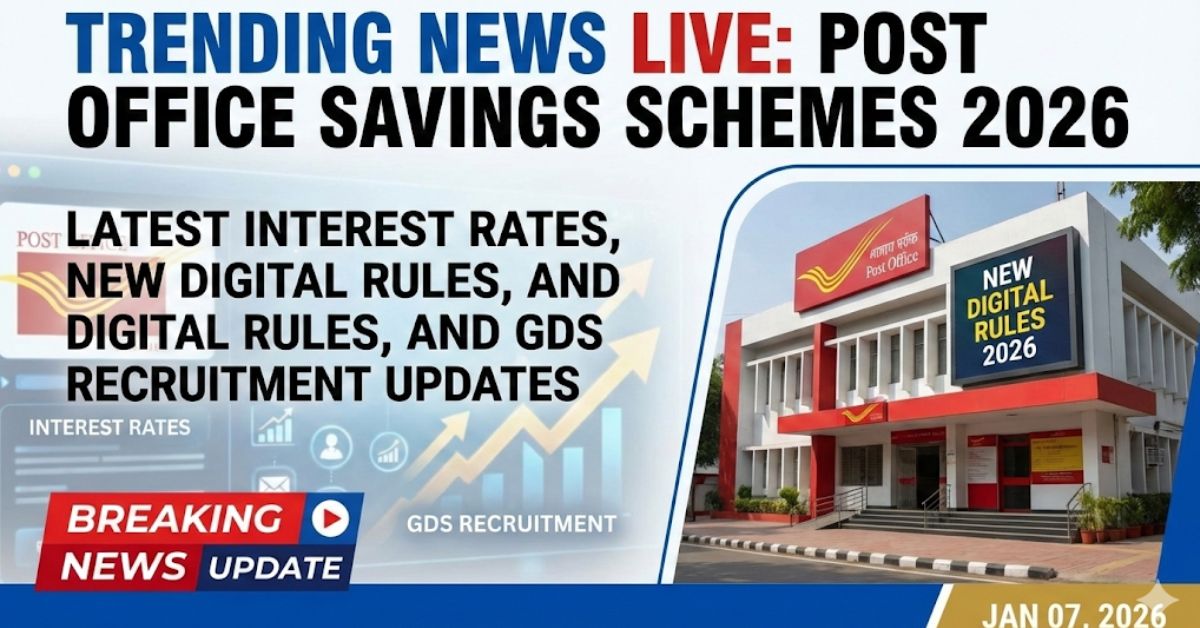
The Indian Post Office is no longer just a place to send letters. As of January 2026, it has transformed into a massive financial hub, offering some of the most secure and high-yielding investment options in the country. With the Ministry of Finance recently announcing the interest rates for the January-March 2026 quarter, millions of small savers, senior citizens, and rural investors are looking to the “Dak Ghar” for financial security.
This year brings a mix of stability and modernization. While interest rates on popular schemes like PPF and Sukanya Samriddhi remain steady, the department is rolling out major digital upgrades under the IT Modernization Project 2.0. Whether you are looking for a safe place to park your savings or seeking a government job through the upcoming GDS Recruitment 2026, here is everything you need to know.
Latest Post Office Interest Rates for Jan-March 2026
For the seventh consecutive quarter, the Government of India has decided to keep the interest rates on small savings schemes unchanged. This decision provides a predictable environment for investors who prefer guaranteed returns over market volatility.
The Sukanya Samriddhi Account (SSA) and the Senior Citizen Savings Scheme (SCSS) continue to lead the pack with a high interest rate of 8.2%. These schemes remain the top choice for parents of girl children and retirees seeking maximum safety. The Public Provident Fund (PPF) remains steady at 7.1%, maintaining its status as a favorite for long-term tax-free wealth creation.
For those looking for monthly liquidity, the Monthly Income Account Scheme (MIS) offers 7.4%. Meanwhile, the Kisan Vikas Patra (KVP) currently matures in 115 months with an interest rate of 7.5%. The standard Post Office Savings Account continues to offer 4%, which remains competitive compared to the 2.5% to 3% offered by many leading private and public sector banks.
Digital Revolution: UPI and IT 2.0
The biggest news for 2026 is the full-scale rollout of the Advanced Postal Technology (APT) platform, also known as IT 2.0. This indigenous system has now been implemented across 1.70 lakh post offices nationwide.
The most visible change for customers is the integration of Unified Payment Interface (UPI). By early 2026, post office counters across India have started accepting digital payments via dynamic QR codes. This solves a long-standing grievance where customers often had to rush to nearby ATMs to withdraw cash for postal transactions. Furthermore, every Gramin Dak Sevak (GDS) is now equipped with a smartphone and biometric device, enabling “Zero Distance” banking where services are delivered right to your doorstep.
India Post GDS Recruitment 2026: 30,000+ Vacancies
For job seekers, the beginning of 2026 brings significant opportunities. India Post is expected to release the official notification for the Gramin Dak Sevak (GDS) Recruitment 2026 in late January. Early reports suggest over 30,000 vacancies for positions like Branch Postmaster (BPM) and Assistant Branch Postmaster (ABPM).
The selection process remains merit-based, meaning there is no written exam. Candidates are selected based on their 10th-grade marks. To be eligible, applicants must be between 18 and 40 years old and have studied the local language of their respective circle up to the 10th standard. The application window is expected to be open throughout February 2026.
Why Post Office Schemes Matter in 2026
In an era of digital fraud and market uncertainty, the Post Office offers “Sovereign Guarantee,” meaning your money is 100% safe with the Government of India. With the new RBI Digital Banking guidelines coming into effect in 2026, India Post is rapidly upgrading its cybersecurity and backend systems to match commercial banks.
The expansion of the Core Banking Solution (CBS) network now allows “Anytime-Anywhere” banking. You can now transfer funds seamlessly between your post office account and any other bank account using NEFT or RTGS, making the post office a viable primary bank for many Indians.
Frequently Asked Questions (FAQs)
1. Is the Post Office interest rate higher than bank FD rates?
In many cases, yes. While some banks offer competitive rates for specific tenures, schemes like the Senior Citizen Savings Scheme (8.2%) and National Savings Certificate (7.7%) often outperform the fixed deposit rates of major banks like SBI or HDFC.
2. Can I open a Post Office account online in 2026?
Yes, if you have a basic Savings Account with IPPB (India Post Payments Bank), you can link it and manage many small savings schemes through the mobile banking app. However, some schemes still require a one-time physical visit for document verification.
3. What is the minimum balance for a Post Office Savings Account?
The minimum balance required to keep a savings account active is ₹500. If the balance falls below this and there is no transaction for three years, the account may become “silent” or dormant.
4. When will the 2026 GDS recruitment merit list be out?
If the application process finishes in February 2026, the first merit list is typically expected by late February or early March 2026.
5. Are Post Office savings tax-free?
It depends on the scheme. PPF is “Exempt-Exempt-Exempt” (EEE), meaning the deposit, interest, and maturity are all tax-free. However, interest from the Monthly Income Scheme (MIS) and Time Deposits is generally taxable.