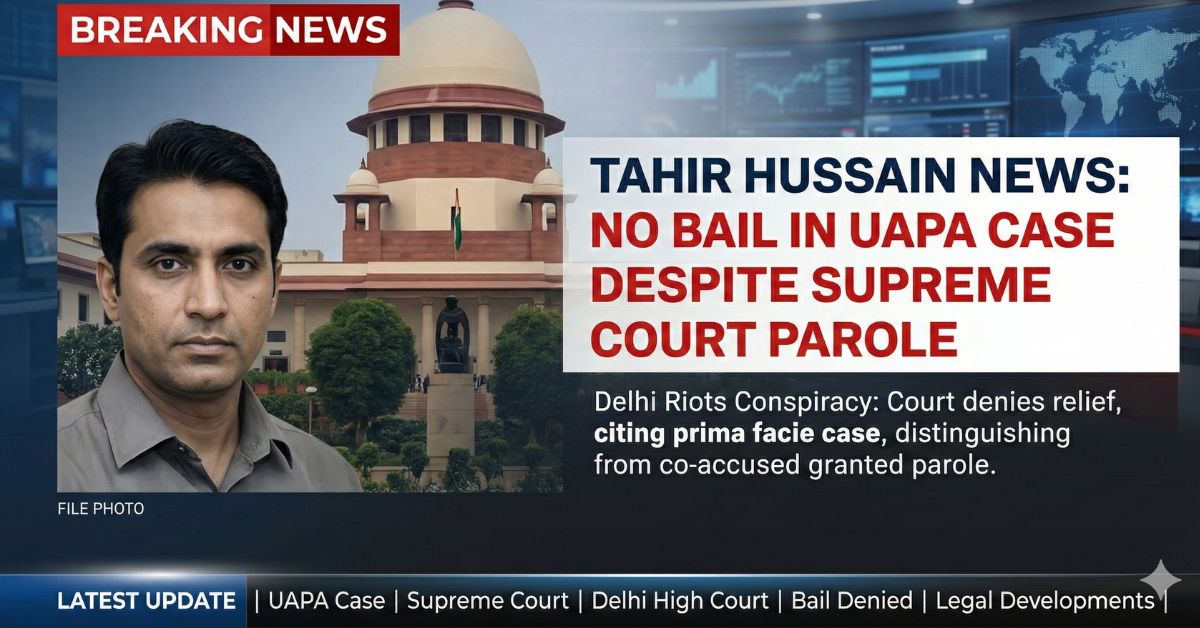
In a major development regarding the 2020 North-East Delhi riots, a Delhi court has rejected the bail plea of former Aam Aadmi Party (AAP) councillor Tahir Hussain. The court announced this decision on Thursday, January 30, 2026.
This ruling comes just days after the Supreme Court granted bail to five other accused people in the same case. However, the trial court clarified that Tahir Hussain’s case is different because he is accused of being a “key conspirator.”
Here is everything you need to know about the latest court order, the charges against Tahir Hussain, and what this means for the ongoing legal battle.
Why Did the Court Reject Bail?
The bail application was heard by Additional Sessions Judge Sameer Bajpai at the Karkardooma Courts in Delhi. Tahir Hussain, along with two other accused (Salim Malik and Athar Khan), had asked for bail on the grounds of “parity.”
What is the argument of parity? Earlier in January 2026, the Supreme Court granted bail to five other people involved in the riots case (including Gulfisha Fatima and Meeran Haider). Tahir Hussain’s lawyers argued that since those accused were released, he should be too.
The Court’s Response: The judge rejected this argument. The court stated that the role attributed to Tahir Hussain is much more serious. The judge noted that there are reasonable grounds to believe the accusations against him are “prima facie true” (true on the face of it).
The court observed that Tahir Hussain is accused of funding the violence and using his position to facilitate the riots. Because of these serious charges under the UAPA (Unlawful Activities Prevention Act), the court decided he must remain in jail.
Read more: Epstein List 2026
What is the “Larger Conspiracy” Case?
The Delhi Police Special Cell is investigating what they call the “larger conspiracy” behind the communal riots that took place in February 2020. The police claim the riots were not spontaneous but were pre-planned to disrupt law and order during the visit of then-US President Donald Trump.
Key allegations against Tahir Hussain include:
- Funding: Accused of laundering money to fund the protests and violence.
- Logistics: Police claim his house was used as a base for rioters to throw stones and petrol bombs.
- Leadership: He is labeled as one of the main organizers.
Under the UAPA law, getting bail is very difficult if the court believes the police evidence is strong at the initial stage.
The Election Twist: Parole Granted
Interestingly, just a few days before this bail rejection, the Supreme Court had granted Tahir Hussain a short parole.
- Why parole? To campaign for the upcoming Delhi Assembly Elections.
- The condition: The court allowed him to be out of jail only during the day (from sunrise to sunset) for about 6 days to file his nomination and campaign.
- The restriction: He has to return to Tihar Jail every evening.
It is important to understand the difference: Parole is a temporary release for a specific reason (like elections), while Bail would have allowed him to stay out regularly until the trial is over. The rejection of regular bail means he will stay in custody after his short parole ends.
Background: Who is Tahir Hussain?
Tahir Hussain was a councillor for the Aam Aadmi Party (AAP) from the Nehru Vihar ward in East Delhi.
- 2020: After his name appeared in the riots investigation and the murder case of IB officer Ankit Sharma, AAP suspended him.
- Present Day: He has reportedly joined the AIMIM party and is trying to contest elections again.
What Happens Next?
Since the lower court (Sessions Court) has denied his bail, Tahir Hussain’s legal team has two main options:
- Appeal to the High Court: They can challenge the Karkardooma Court’s order in the Delhi High Court.
- Stay in Jail: Unless a higher court overturns this order, he will remain in judicial custody as an undertrial prisoner.
The police have stated that the trial is still pending and releasing key accused persons could harm the case.
Frequently Asked Questions (FAQs)
Q1: Why is Tahir Hussain in jail?
He is in jail for multiple cases related to the 2020 North-East Delhi riots, including charges of funding the violence, conspiracy, and the murder of an IB official.
Q2: Did the Supreme Court release him?
No. The Supreme Court only granted him temporary parole (daytime release) for a few days to campaign for elections. They did not grant him regular bail in the main conspiracy case.
Q3: What is the UAPA Act?
UAPA stands for Unlawful Activities (Prevention) Act. It is a strict anti-terror law in India where getting bail is very hard because the burden of proof is heavy on the accused.
Q4: Which party is Tahir Hussain associated with now?
After being suspended by AAP in 2020, reports in 2026 suggest he is contesting elections on an AIMIM ticket.
Q5: When did the Delhi riots happen?
The riots took place in February 2020 in North-East Delhi.