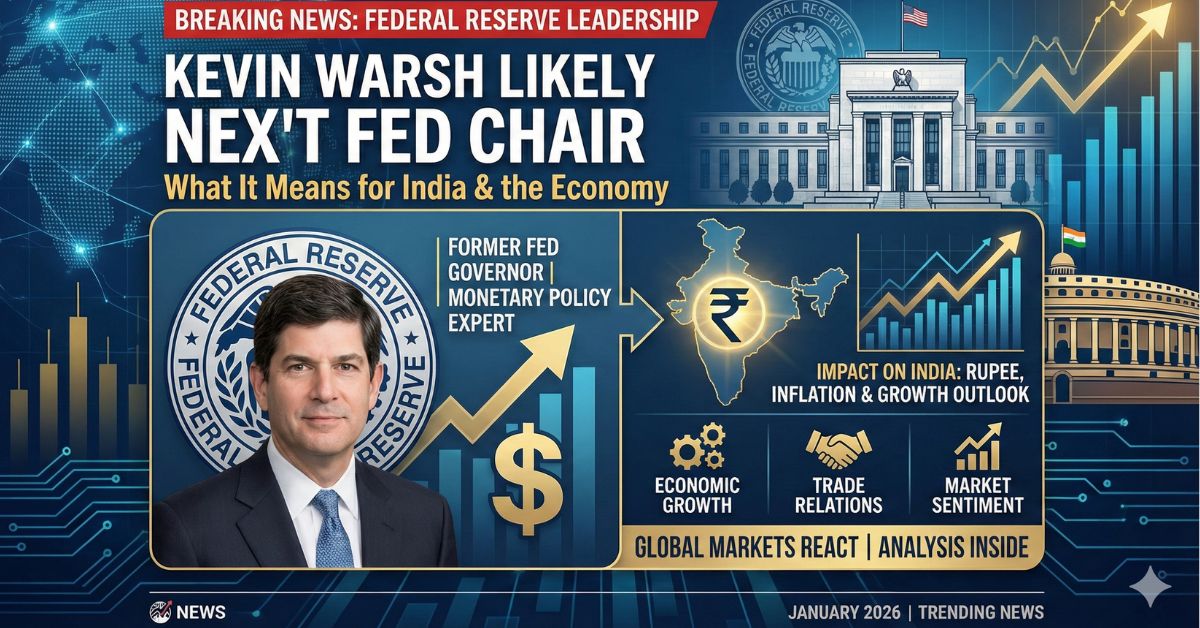
The race to lead the world’s most powerful central bank has taken a dramatic turn. Former Federal Reserve Governor Kevin Warsh is now the clear frontrunner to become the next Chair of the US Federal Reserve, succeeding Jerome Powell.
This shift comes after President Donald Trump signaled that his other top choice, Kevin Hassett, will likely remain in the White House. For global markets—and especially for India—Warsh’s potential appointment signals a major shift in how the US manages money, interest rates, and inflation.
Here is everything you need to know about Kevin Warsh, his “hard money” views, and how his leadership could impact the Indian economy, the Rupee, and the stock market.
The Big News: Why Kevin Warsh?
For weeks, Wall Street has been guessing who Donald Trump would pick to replace Jerome Powell when his term ends in May 2026. The two main contenders were Kevin Warsh (a former banker and Fed official) and Kevin Hassett (Trump’s top economic advisor).
On Friday, President Trump effectively ended the suspense. He told reporters he wants to keep Hassett in his current role as Director of the National Economic Council because he is “too valuable” to lose.
The result? Betting markets instantly swung in Warsh’s favor. As of today, Warsh is seen as the almost-certain nominee. This news has already started moving the US Dollar and bond yields, as investors prepare for a stricter, more disciplined Federal Reserve.
Read more: Subhadra Yojana Update 2026
Who Is Kevin Warsh?
Kevin Warsh is not new to the Federal Reserve. He served as a Fed Governor from 2006 to 2011, where he was the youngest member of the board.
- Background: A former Morgan Stanley banker, he understands Wall Street deeply.
- Reputation: He is known as a “hawk” (someone who hates high inflation) rather than a “dove” (someone who prefers low interest rates to boost jobs).
- The “Adult in the Room”: Trump calls him smart and handsome, often comparing him to a central casting version of a banker. While Trump demands lower interest rates, Warsh has historically criticized “easy money” policies.
Warsh vs. Powell: A Stricter Approach?
If confirmed, Warsh could be very different from Jerome Powell.
1. The End of “Free Money”
Warsh has frequently criticized the Fed for printing too much money (Quantitative Easing). He believes that when money is too cheap, it creates bubbles in the stock market and housing. He might try to shrink the Fed’s balance sheet, which means pulling money out of the economy to ensure long-term stability.
2. Inflation Fighter
While Trump wants rate cuts to boost growth, Warsh believes inflation is a “choice.” He is expected to prioritize sound money over short-term stock market gains. This could mean fewer interest rate cuts than the market currently expects in 2026.
3. The Crypto Skeptic
Warsh has a unique view on cryptocurrency. He once famously said, “Crypto is not money, it is software.”
- He is skeptical of private cryptocurrencies like Bitcoin challenging the US Dollar.
- However, he supports a “Wholesale CBDC” (Central Bank Digital Currency)—using blockchain technology for official bank-to-bank transfers.
- Impact: Under Warsh, we might see stricter regulations on stablecoins (like USDT/USDC) but better infrastructure for banking technology.
Impact on India: Sensex, Rupee, and RBI
Why should an Indian investor or job seeker care about a US Fed Chair? Because the Fed controls the flow of global capital.
1. Pressure on the Rupee (INR)
Warsh is viewed as a “strong dollar” candidate. If he tightens money supply, the US Dollar Index (DXY) could rise.
- The Risk: A stronger dollar makes the Indian Rupee weaker. This makes imports (like oil and electronics) more expensive for India, potentially increasing local inflation.
2. FII Outflows
Foreign Institutional Investors (FIIs) pour money into India when US rates are low. If Warsh keeps US rates higher or cuts them slowly, FIIs might prefer to keep their money in safe US bonds rather than Indian stocks. This could lead to volatility in the Nifty and Sensex.
3. RBI’s Policy
The Reserve Bank of India (RBI) often follows the Fed’s lead. If the Warsh-led Fed stays hawkish (strict), the RBI may be forced to delay its own interest rate cuts to protect the Rupee. This could mean home loans and car loans in India stay expensive for a bit longer.
What Happens Next?
President Trump is expected to make the official announcement within days.
- The Process: Once nominated, Warsh must be confirmed by the US Senate. Given the Republican majority, he is likely to pass, but he will face tough questions about his independence from Trump.
- The Timeline: Jerome Powell’s term ends in May 2026. If confirmed, Warsh would take over then, but his influence on markets would begin immediately.
Frequently Asked Questions (FAQs)
Q1: Is Kevin Warsh officially the new Fed Chair?
Not yet officially. However, he is the top frontrunner after President Trump signaled he won’t pick the other main candidate, Kevin Hassett. An official announcement is expected this week.
Q2: Will Kevin Warsh cut interest rates?
He might cut rates eventually, but he is generally stricter than Jerome Powell. He dislikes “easy money” and may not cut rates as fast or as deeply as the market hopes.
Q3: Is Kevin Warsh good for the stock market?
Short-term, maybe not. Markets often prefer “dovish” Chairs who print money. Warsh prefers long-term stability over short-term pumps, which could cause some initial volatility.
Q4: Does Kevin Warsh like Bitcoin?
He is skeptical. He views Bitcoin as “software,” not real money, and believes the US Dollar should remain dominant. He may push for stricter rules on crypto.
Q5: How does this affect Indian investors?
A Warsh-led Fed could lead to a stronger US Dollar. This might cause short-term dips in Indian markets (Sensex/Nifty) as foreign money moves back to the US, and it could keep Indian loan interest rates higher for longer.