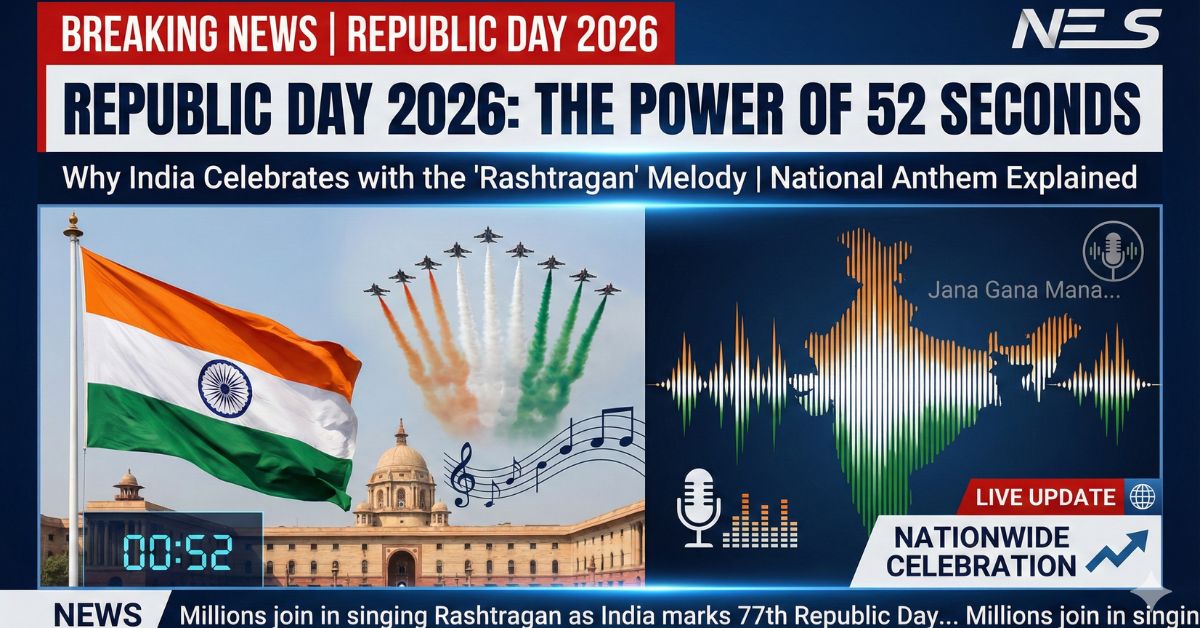
As the Tricolour unfurls on the 77th Republic Day, the melody of ‘Jana Gana Mana’ unites 1.4 billion Indians. Here is everything you need to know about the National Anthem, its code of conduct, and how it differs from the National Song.
On January 26, 2026, the air across India will resonate with the 52-second melody of the Rashtragan (National Anthem). From the grand parade at Kartavya Path to school assemblies in remote villages, singing ‘Jana Gana Mana’ is the ultimate act of patriotism.
However, Republic Day 2026 is special because of a parallel celebration: the government is also marking 150 years of ‘Vande Mataram’ (the National Song). This has led to some confusion among citizens regarding the difference between Rashtragan and Rashtrageet. This article clarifies the rules, history, and the distinct roles of these two powerful songs.
The Code of Conduct: 52 Seconds of Discipline
The National Anthem is not just a song; it is a symbol of national sovereignty. The Ministry of Home Affairs has a specific Code of Conduct that every citizen must follow.
Read more: Bactrian Camels Debut at R-Day Parade
1. Duration and Timing
- Full Version: The official duration of the National Anthem is approximately 52 seconds. It must be sung at a steady pace—neither too fast nor too slow.
- Short Version: On specific occasions (like drinking toasts in military messes), a shorter version consisting of the first and last lines is played. This lasts about 20 seconds.
2. Posture and Respect
- Stand at Attention: Whenever the National Anthem is sung or played, everyone present must stand in a respectful “Attention” posture.
- No Movement: Walking, talking, or eating during the anthem is considered disrespectful.
- Exceptions: Persons with disabilities (e.g., wheelchair users) are exempt from standing but must show respect by remaining still and attentive.
3. Legal Protection
Insulting the National Anthem is a punishable offense under the Prevention of Insults to National Honour Act, 1971. Intentional disruption can lead to imprisonment for up to three years.
Rashtragan vs. Rashtrageet: Clearing the Confusion
A common question on Google Trends during Republic Day is: “What is the difference between Rashtragan and Rashtrageet?”
| Feature | Rashtragan (National Anthem) | Rashtrageet (National Song) |
| Title | Jana Gana Mana | Vande Mataram |
| Author | Rabindranath Tagore | Bankim Chandra Chatterjee |
| Language | Bengali (Sanskritized) | Sanskrit & Bengali |
| Status | Adopted on Jan 24, 1950 | Equal status to Anthem |
| 2026 News | Standard Flag Hoisting Protocol | Theme of R-Day 2026 (150 Years) |
Important Update for 2026: While ‘Jana Gana Mana’ remains the anthem played during the flag hoisting, the Republic Day Parade 2026 theme is centered on “150 Years of Vande Mataram.” This is why you will see special tableaus and performances dedicated to the National Song this year.
History: The Journey from 1911 to 2026
The Rashtragan has a historic legacy that predates India’s independence.
- Origin: It was first sung on December 27, 1911, at the Calcutta Session of the Indian National Congress.
- The Myth: There is a long-standing myth that it was written for King George V. However, Rabindranath Tagore himself denied this, stating that the “Dispenser of India’s Destiny” (Bharat Bhagya Vidhata) referred to God, not the British Monarch.
- Adoption: The Constituent Assembly officially adopted ‘Jana Gana Mana’ as the National Anthem on January 24, 1950, just two days before India became a Republic.
Why It Matters Today
In a diverse country like India, the Rashtragan serves as a binding force. The lyrics mention various regions—Punjab, Sindh, Gujarat, Maratha, Dravida, Utkala, Banga—reminding us that despite our different languages and cultures, we are one nation under one flag.
On Republic Day, when the President unfurls the flag and the anthem plays, it is a reaffirmation of our commitment to the Constitution and the idea of a united India.
Frequently Asked Questions (FAQs)
Q1: Is it mandatory to stand for the National Anthem in cinema halls?
As per the latest Supreme Court rulings, it is not mandatory to play the anthem in cinema halls before a movie. However, if it is played, the audience is expected to stand to show respect. If the anthem is part of the movie’s storyline (inside the film), standing is not required.
Q2: What is the exact time duration of the National Anthem?
The full version of the National Anthem should take approximately 52 seconds to sing.
Q3: Can we clap after singing the National Anthem?
No, clapping after the National Anthem is considered a breach of decorum. The anthem should be followed by silence or a solemn patriotic slogan like “Bharat Mata Ki Jai.”
Q4: Who wrote the National Anthem of India?
The National Anthem was written and composed by Rabindranath Tagore (originally in Bengali).
Q5: Why is ‘Sindh’ still in the National Anthem if it is in Pakistan?
The word ‘Sindh’ in the anthem represents the Sindhi community and the culture of that region, which is an integral part of India’s shared heritage, regardless of modern political borders.