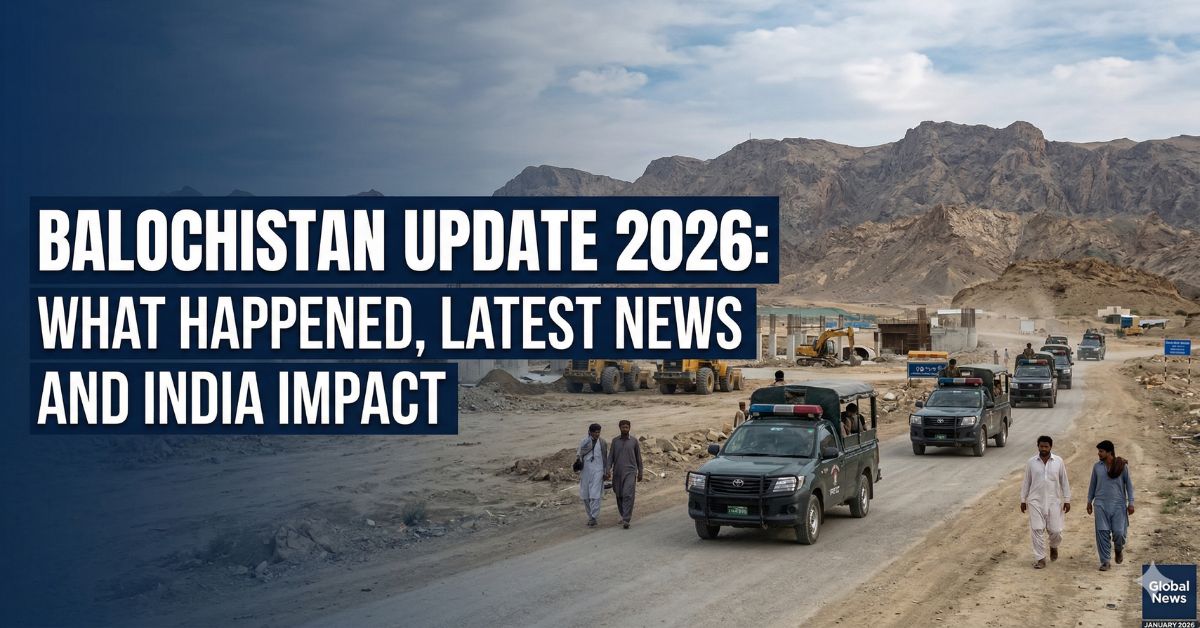
The situation in Balochistan Update 2026 has once again become a major global concern in 2026. A series of deadly attacks, military operations, and political developments have brought the region back into headlines. This article explains what has happened, why it matters, and how it could impact India and the region.
What Happened in Balochistan in 2026?
In late January 2026, Balochistan saw one of the biggest waves of violence in recent years. Armed militants linked to the Baloch Liberation Army (BLA) launched coordinated attacks across multiple cities including Quetta, Gwadar, and Nushki.
These attacks targeted police stations, government buildings, markets, and even civilian areas. Militants used guns, grenades, and suicide bombings, making it one of the most widespread operations in the region’s history.
According to reports, dozens of civilians and security personnel were killed, while Pakistani forces responded with large-scale military operations.
Pakistan claimed to have killed over 100 militants in counter-operations within 40 hours.
Scale of Violence and Key Details
The 2026 attacks were not isolated incidents. They were part of a coordinated campaign named “Operation Herof 2.0” by separatist groups.
- Attacks happened in more than 10 districts
- Multiple suicide blasts and armed assaults were reported
- Civilian areas like banks, schools, and markets were targeted
- Security forces used drones and helicopters to regain control
In some areas, militants even briefly took control of towns before being pushed back.
Background: Why Balochistan Is Always in Conflict
Balochistan is Pakistan’s largest province but remains underdeveloped despite rich natural resources like gas and minerals.
The conflict is decades old. Local groups have long accused the Pakistani government of:
- Ignoring development needs
- Exploiting resources
- Human rights violations
This has led to an insurgency by separatist groups like the BLA, who demand autonomy or independence.
There have also been past incidents such as bombings and attacks on security forces, showing that instability is not new to the region.
Recent Political Developments in 2026
Apart from violence, administrative changes have also taken place.
Pakistan recently created new districts like Tump and Barshore in Balochistan to improve governance.
However, experts believe that administrative changes alone may not solve deeper political and social issues.
Why This Matters for India
The Balochistan issue often becomes sensitive for India due to geopolitical tensions.
Pakistan has repeatedly accused India of supporting insurgents, which India has denied.
For India, the situation matters because:
- It affects regional stability in South Asia
- It impacts relations between India, Pakistan, and Afghanistan
- It has implications for China-backed projects like Gwadar port
Any escalation can increase tensions in the region and affect diplomatic relations.
Global Reactions and Strategic Concerns
Internationally, the violence has raised concerns about terrorism and instability.
The United States has condemned the attacks and continues to classify groups like the BLA as terrorist organizations.
Experts also warn that the lack of political solutions and continued military response may worsen the conflict.
What Happens Next?
Pakistan has launched large-scale security operations to control the situation.
However, the long-term future remains uncertain. Key questions include:
- Will political dialogue happen?
- Can development reduce unrest?
- Will violence increase further?
So far, the conflict shows no clear signs of ending soon.
Impact on Common People
The biggest impact is on civilians living in Balochistan.
Read More : Big Updates: Iran Attacks 2026 Explained: Latest News, Global Impact & What It Means for India
People face:
- Loss of lives and property
- Disruption of daily life
- Fear due to ongoing violence
The region continues to struggle with both security and development challenges.
FAQ: Balochistan Update 2026
1. What is happening in Balochistan in 2026?
A series of large-scale militant attacks and military operations have increased violence in the region.
2. Who is responsible for the attacks?
The Baloch Liberation Army (BLA), a separatist group, has claimed responsibility.
3. Why is there conflict in Balochistan?
The conflict is due to political, economic, and human rights issues over many years.
4. How many people were affected?
Dozens of civilians and security personnel were killed, along with many militants.
5. Does this affect India?
Yes, it impacts regional stability and India-Pakistan relations.