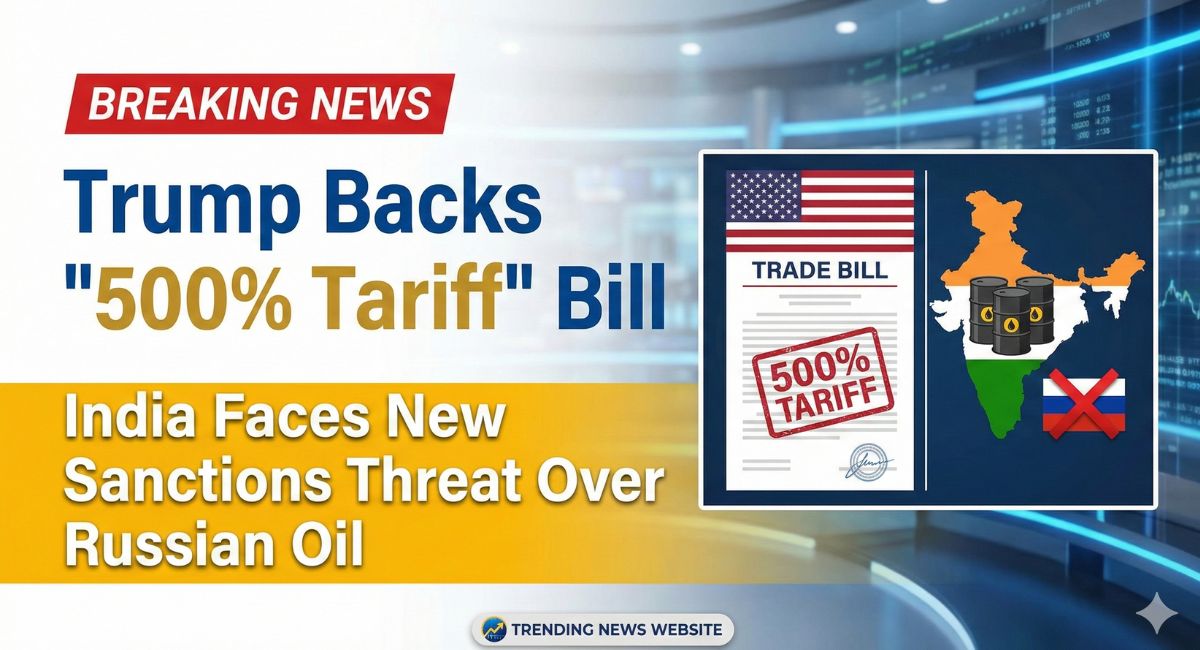
In a stunning escalation of his “America First” economic policy, US President Donald Trump has officially thrown his weight behind a new bipartisan bill that could impose tariffs of up to 500% on countries that continue to purchase Russian oil. The announcement, made on Thursday, January 8, 2026, has sent shockwaves through the Indian markets and diplomatic circles.+1
This move comes just days after President Trump publicly admitted that Prime Minister Narendra Modi is “not happy” with him due to the existing heavy duties on Indian exports.
The “Sanctioning Russia Act”: What We Know
According to reports from Washington, President Trump has “greenlit” a legislative push led by influential Republican Senator Lindsey Graham. The proposed bill aims to punish nations that are seen as funding Russia’s war effort in Ukraine by purchasing its discounted crude oil.+1
Key Provisions of the Threat:
- Target: Countries doing business with Russia’s energy sector (primarily India and China).
- Penalty: Authority to impose a staggering 500% tariff on goods imported from these countries into the US.
- Trump’s Stance: Speaking from Air Force One, Trump stated that Washington has the ability to raise tariffs “very quickly” if New Delhi does not address US concerns.
Current Impact: 50% Duty Already hurting Exporters
It is important to note that Indian exporters are already suffering. Since late 2025, the US has imposed a cumulative 50% tariff on many Indian goods.+1
- 25% Reciprocal Tax: Levied in response to India’s own tariffs.
- 25% “Oil Penalty”: An additional surcharge specifically linked to India’s purchase of Russian S-400 systems and crude oil.
Sectors like textiles, gems and jewelry, and leather—which rely heavily on American buyers—are reportedly seeing a sharp decline in orders. If the new 500% bill passes, it could effectively shut the door for Indian products in the US market.
“Modi is Not Happy,” Says Trump
On Tuesday (January 6), while addressing a GOP retreat, President Trump made a candid revelation about his personal equation with PM Modi.
“I have a very good relationship with him (Modi). He is a good guy. But he is not that happy with me because they are paying a lot of tariffs now,” Trump said.
He further claimed that India has reduced its Russian oil imports “very substantially” in recent weeks to appease Washington, though Indian officials have not officially confirmed any change in energy policy.
Double Trouble: The H-1B Visa Crisis
While trade wars loom, Indian professionals in the US are fighting a separate battle. A US Appeals Court has agreed to fast-track a hearing on the controversial $100,000 H-1B visa fee introduced by the Trump administration.
- The Issue: The new rule raised visa fees from a few thousand dollars to a massive $100,000 for certain categories, making it nearly impossible for Indian IT firms to hire talent.
- Status: A decision is expected in February 2026, just before the March lottery season.
What Happens Next?
All eyes are now on the upcoming visit of the US Ambassador-designate Sergio Gor to New Delhi this weekend. Diplomatic experts believe this visit will be crucial. India will likely push for a waiver or a “middle path” to save its exports without compromising its energy security.
For now, the message from the White House is clear: Stop buying Russian oil, or face an economic wall.
Frequently Asked Questions (FAQs)
Q1. Why is the US threatening 500% tariffs on India?
The US government, led by Donald Trump, wants to stop countries from buying oil from Russia to cut off funding for the Russia-Ukraine war. The proposed bill allows huge tariffs on nations that ignore this warning
Q2. Is there already a tariff on Indian goods?
Yes. Currently, many Indian goods face a 50% tariff in the US. This includes a 25% penalty specifically because India buys oil from Russia
Q3. What did Trump say about PM Modi recently?
Trump said he has a “good relationship” with PM Modi but admitted that Modi is “not happy” with him because of the high taxes the US has put on Indian products.
Q4. How does this affect Indian jobs?
If tariffs increase, Indian companies (especially in textiles and IT) cannot sell to the US cheaply. This leads to loss of orders and potential job cuts in export-oriented industries.
Q5. What is the news on H-1B visas?
There is a court case going on regarding a new $100,000 fee for H-1B visas. A US court has agreed to decide on this matter quickly, likely by February 2026.