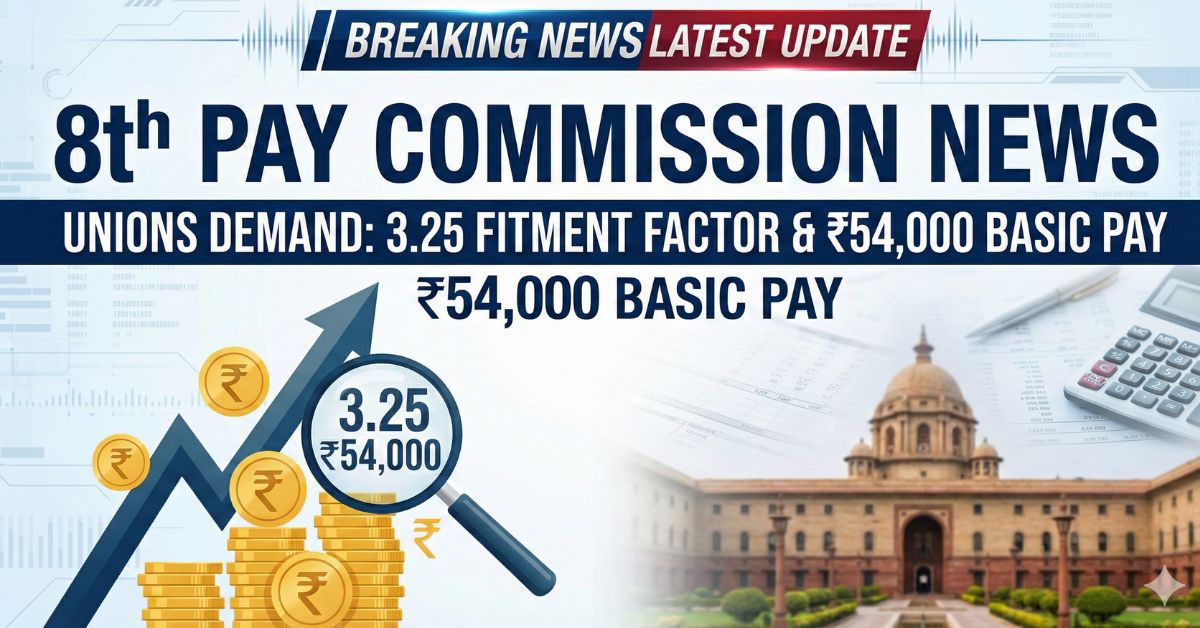
New Delhi: As the Union Budget 2026 approaches, the buzz around the 8th Pay Commission has reached a fever pitch. In a major development this week, central government employee unions have officially escalated their demands, calling for a significant hike in the “Fitment Factor” that could triple the minimum salary for entry-level staff.
If you are a central government employee or pensioner waiting for a salary revision, here is the latest update on the fitment factor proposals, the new salary structure demands, and the critical meeting scheduled for February.
What is the New Demand?
The Federation of National Postal Organisations (FNPO), a key body representing government employees, has submitted a formal proposal to the National Council Joint Consultative Machinery (NC-JCM). The letter outlines a demand for a Fitment Factor ranging from 3.0 to 3.25.
Currently, under the 7th Pay Commission, the fitment factor was set at 2.57. The unions argue that inflation and the rising cost of living in 2026 make the old multiplier obsolete.
Proposed Fitment Factor Breakdown:
The union has suggested a “graded” approach rather than a single number for everyone:
- Levels 1 to 5 (Entry Level/Group C): 3.00 Fitment Factor
- Levels 6 to 12 (Middle Management): 3.05 to 3.10 Fitment Factor
- Levels 13 and above (Senior Officers): 3.15 to 3.25 Fitment Factor
Impact: Minimum Salary Could Jump to ₹54,000
The most headline-grabbing aspect of this proposal is the change in the Minimum Basic Pay.
- Current Status: Under the 7th Pay Commission, the minimum basic pay is ₹18,000.
- The Calculation: If the government accepts the demand of a 3.0 fitment factor, the new minimum salary will be:$$18,000 \times 3.0 = \text{₹54,000}$$
This would be a massive relief for lower-level employees who have been struggling with stagnant real wages. For senior officers (Cabinet Secretary level), a 3.25 factor could push the maximum basic pay to over ₹8 Lakh per month.
Annual Increment Hike: From 3% to 5%
Apart from the fitment factor, the unions are also demanding a change in the annual appraisal system. Currently, central government employees receive a standard 3% annual increment. The FNPO has argued that this should be increased to 5% to keep pace with private sector growth and inflation.
Timeline: What Happens Next?
The ball is now moving in the corridors of power.
- Budget 2026 (Feb 1): All eyes are on Finance Minister Nirmala Sitharaman. While a full announcement might take time, a mention of the Pay Commission formation is highly anticipated.
- February 25 Meeting: The NC-JCM is reportedly scheduled to meet the draft committee on February 25, 2026. This meeting will be crucial in finalizing the “Staff Side” recommendations that will be sent to the Pay Commission Chairperson.
- Implementation: While the 8th Pay Commission is due from January 1, 2026, the actual implementation often takes time. If delayed, employees will likely receive arrears for the intervening period.
Why This Matters
The 8th Pay Commission is not just about government salaries; it sets a benchmark for state governments, PSUs, and the broader organized sector in India. With over 48 lakh employees and 68 lakh pensioners directly affected, this decision will have a massive economic impact.
The government is currently balancing these demands against fiscal prudence, but with the general elections behind them and state elections looming, a favorable decision for employees cannot be ruled out.
Frequently Asked Questions (FAQs)
Q1. What is the Fitment Factor in the 8th Pay Commission?
The Fitment Factor is a multiplier used to calculate the new basic pay from the old basic pay. For example, if your current basic pay is ₹18,000 and the factor is 3.0, your new pay becomes ₹54,000.
Q2. When will the 8th Pay Commission be implemented?
The 8th Pay Commission is technically due for implementation from January 1, 2026. However, the official notification and salary credit usually take 12–18 months, with arrears paid later.
Q3. Will the minimum salary really become ₹54,000?
This is currently a demand from the employee unions. The government has not yet approved this figure. Analysts expect a compromise, possibly around a fitment factor of 2.86.
Q4. Who is demanding the 3.25 fitment factor?
This is currently a demand from the employee unions. The government has not yet approved this figure. Analysts expect a compromise, possibly around a fitment factor of 2.86.
Q5. Will pensioners also get a hike?
Yes, the Pay Commission recommendations apply to pensioners as well. Their basic pension will be revised using the same fitment factor logic.